
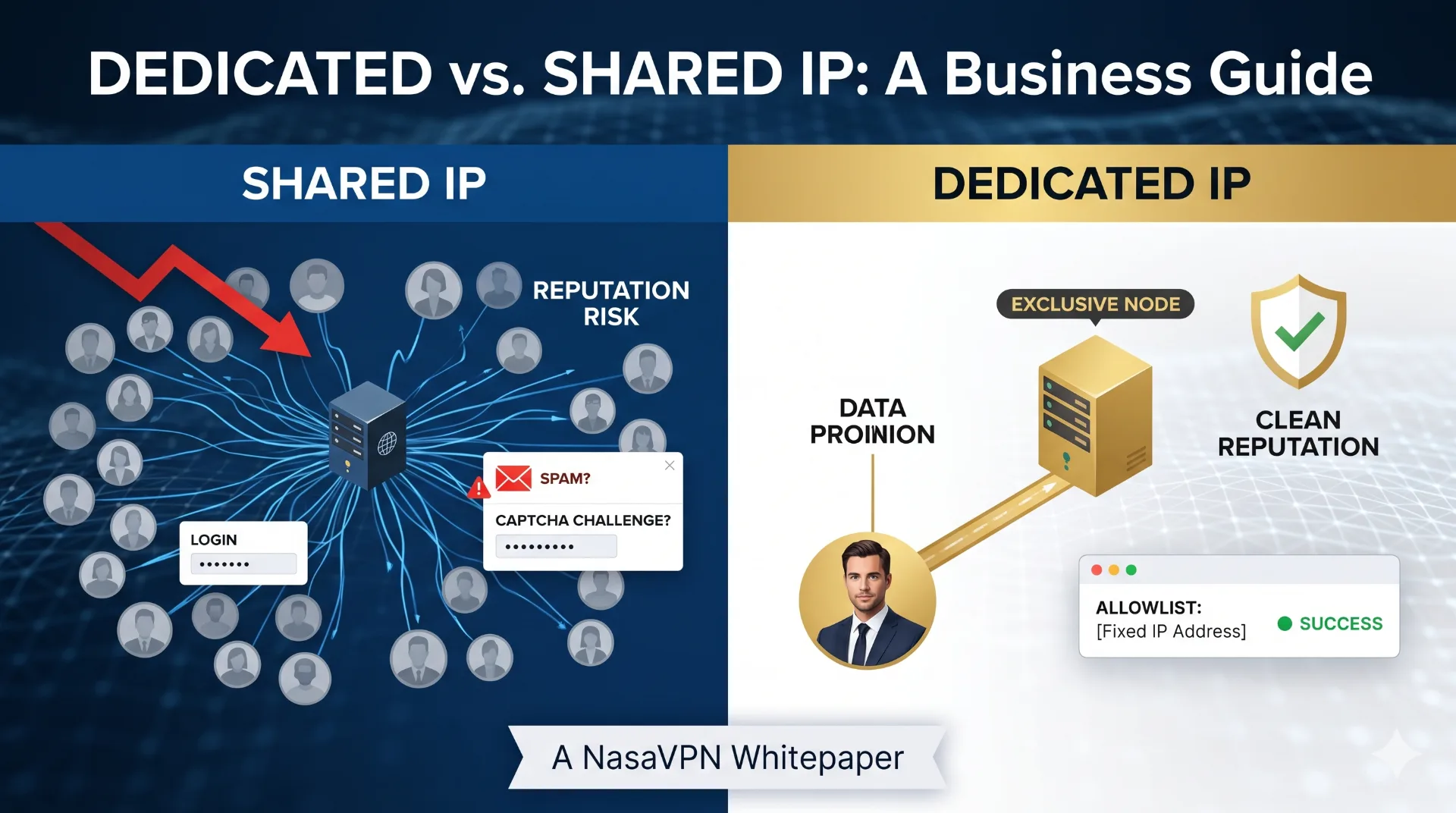
If anything in your stack has to be trusted by another system, a payment gateway, a mail server, a remote-access portal, then the IP address behind your connection quietly does more work than most teams give it credit for. The split is simple to state. A dedicated IP belongs to one account and no one else. A shared IP gets rotated across many users at the same time. That one difference decides whether your logins get challenged, whether your email lands in the inbox, and whether an allowlist entry survives past lunchtime.
Below is a practical, point-by-point look at how the two models behave once they hit a real business, so you can match the choice to what you actually run instead of to a label on a pricing page. NasaVPN built its network on dedicated IPs and exclusive nodes for the reasons that follow, which tend to surface in deployments rather than in brochures.
What changes the moment your address stops being shared
On a shared IP your outbound traffic exits through an address that dozens, sometimes hundreds, of other people are using right alongside you. To every service you touch, all of that mixed activity reads as coming from a single origin. A dedicated IP inverts the arrangement: the address is yours, it holds steady between sessions, and nothing a stranger does ever lands on your record.
A few consequences follow, and operations teams run into them sooner or later.
- The address does not shift between connections, so anything that keys off your IP keeps recognising you.
- You stop inheriting the rate limits and blocks that someone else's behaviour triggered.
- A fixed address can go into a firewall rule or a partner's access list and actually stay valid there.
- When something breaks, the address is a known constant instead of one more moving part to chase.
Allowlisting is the feature that breaks on a shared IP
A surprising slice of business connectivity headaches come down to one demand from the other side: a remote system that will only talk to an address it already knows. Internal admin panels, banking portals, supplier APIs, SaaS dashboards. Plenty of them let you restrict access to a single IP, and that control is genuinely useful, but only if your address never moves.
With a shared IP, the address you leave through can be different from one session to the next. The allowlist entry you carefully created may stop matching within hours, and now you are locked out of your own banking portal at the worst possible time. A dedicated IP turns allowlisting from a flaky workaround into something a security team can lean on. That alone is why finance, legal and engineering tend to ask for it first.
Reputation: you inherit the neighbours you never met
Every IP carries a reputation score. Mail providers, fraud engines and content platforms read it before they decide how to treat a request. On a shared address, that score is the running total of everyone behind it. One user blasting spam or scraping too hard can get the whole address captcha-walled, throttled or blacklisted, and you feel the consequences without ever learning the cause.
The part that makes it maddening
You did nothing. Yet logins start asking for verification, and transactional email begins quietly sliding into spam folders. Because the damage was someone else's doing, there is nothing in your own logs to point at. A dedicated IP gives you a reputation shaped only by your own conduct. For teams that send transactional mail, run ad accounts, or work against platforms with aggressive anti-abuse systems, that isolation is often the line between a normal day and a slow drip of verification prompts.
Access control once the office perimeter is gone
When staff log in from home networks, cafes and hotel lobbies, the old idea of a trusted office perimeter stops applying. A dedicated IP gives you a new one. Company resources can be set to accept connections only from that address, and every session funnels through it no matter where the employee happens to be sitting.
There is a second payoff that audit and compliance people appreciate. When traffic consistently originates from one known address, security logs get much easier to read. Genuine anomalies stand out instead of hiding inside the churn of rotating shared addresses, which shortens investigations and makes compliance reporting less of a slog.
Performance, and why steady beats fast
Shared IPs usually live on shared infrastructure, so you are competing for bandwidth with everyone else on the same node, and that competition is sharpest exactly when you need the connection most. A dedicated IP delivered over an exclusive node takes that contention off the table. The capacity behind your address is not being carved up among unrelated strangers.
For latency-sensitive work, video calls, remote desktop, large transfers, a predictable floor matters far more than a flashy peak that only shows up when the node happens to be empty. An exclusive node holds its throughput through the busy hours when contended capacity sags. Business workflows are built on the floor, not the ceiling.
When a shared IP is the smarter pick
Dedicated is not automatically the right answer. Shared IPs carry a real privacy advantage, because blending your traffic into a crowd makes any single user harder to isolate, and they cost less. For casual browsing, general privacy, or any case where you actively do not want a persistent identity following you around, a shared IP is the more sensible choice.
The decision usually sorts itself once you frame it this way:
| Consideration | Shared IP | Dedicated IP |
| Cost | Lower | Small recurring add-on |
| Allowlisting | Unreliable, address rotates | Works, address is fixed |
| Reputation | Shared with everyone on it | Reflects only your activity |
| Crowd-blending privacy | Strong | Weaker, identity is persistent |
| Performance under load | Contended at peak | Steady on an exclusive node |
How to decide for your own setup
Skip the price-first reflex and run your real requirements through a short list:
- Do any services you rely on restrict access to a known IP? If yes, lean dedicated.
- Do you send transactional email or manage accounts on abuse-sensitive platforms? A clean, isolated reputation argues for dedicated.
- Do remote staff need one trusted origin for company systems? Dedicated makes allowlisting workable.
- Is anonymity and the lowest possible cost your priority for general use? A shared IP probably serves you better.
- Do you need a predictable performance floor rather than contended capacity? Dedicated, on an exclusive node.
Most organisations land in a mixed place: dedicated for the systems that simply have to be reliable, shared for everything else. Which is the real argument for a provider that offers both cleanly, rather than one that pushes you into a single model and calls it a feature.
Common questions
Will a dedicated IP fix my emails going to spam?
If the problem is a poisoned shared address, yes, it removes the contamination. A dedicated IP starts clean and stays clean as long as your own sending is well-behaved. It will not rescue you from genuinely spammy content or a missing SPF and DKIM setup, so treat it as one piece of deliverability rather than the whole fix.
Is a dedicated IP less private than a shared one?
In the crowd-blending sense, slightly, because the address is persistent and traceable to your account rather than lost in a pool. For business use that tradeoff is usually worth it, since the whole point is to be a recognisable, trusted origin. For pure anonymity, shared still wins.
Can I run both?
That is the setup a lot of teams settle on. Route the systems that need a stable, allowlisted, reputation-clean address through a dedicated IP, and keep a shared option for general traffic where blending in is fine.
In the end the shared-versus-dedicated question is less about which is better in the abstract and more about whether your work depends on a stable, trusted, reputation-clean address. When it does, the modest recurring cost of a dedicated IP pays for itself in fewer blocks, simpler access control, and connections you can actually count on. NasaVPN provisions dedicated IPs on exclusive nodes built for exactly that kind of business-critical access, which is a reasonable place to start if a stable, allowlist-ready address is the piece that has been missing.